Friday, 10 January 2020

YEAR THREE: Pre-Production (Genre & Format)

 When researching genre and format, I found starting with the BBC writer’s room a great place to start asking myself important questions, such as where my programme would ideally be shown, how it would fit into that schedule, what type of story I wanted to tell and many more.  

 I looked at shows similar to mine – a university drama/comedy - to gauge an appropriate amount of episodes as well as what themes and storytelling usually featured. Channel 4’s ‘Fresh Meat’ was always a big inspiration for my show, not just as a uni-based show but the artful way it balances comedy and drama and tackled issues such as drug and alcohol abuse, homesickness and house relationships. Fresh Meat episodes were typically 40 minutes long and consisted of roughly 8 episodes a season, Skins (another major inspiration, especially when first developing the characters) varied it’s season lengths from 8-10 episodes and episodes were typically 40 minutes long. I initially planned to write 7x40 episodes but lowered this to 6x40, feeling this best reflected the story I was telling and hoping to better focus my attention with less episodes.  
Where Skins was priary inspiration for original, college script - Fresh Meat was the initial push informing this script in what I wated to achieve. ENjoyed whole show but primarily later seasons, and Josie's story where she fails and has to consider and prepare for life without her established friends. Wanted to push this very human element into foreground, and focus less on typical aspects such as partying and looking at the more disruptive sides of these tropes when they do. 
Experiences tension over idea of house being a 'family' when living in own uni house and - as something kind of touched on in Fresh Meat and other such shows - was something I wanted to really explore with my show. Comparing their actual family with their 'constructed' family at university and whether it's as cemented as they think. 

 Heavily informed general language and tone - using idea of youth (not fragililt but something like it) FRAGILITY to combine drama and comedy, sometimes in dismissive ways, sometimes to highlight one. 
 The Television Genre Book was incredibly informative when detailing critical formal elements of youth drama as well as building my historical context of British youth programming. It explained how in 1979 the Gulbenkian Report found that there was no TV programming for teens or young people in Britain – leading to the development of two shows, ‘Going Out’ & ‘Maddie’ and eventually ‘llyoaks’, Britain’s first successful ongoing teen drama (that still runs today). This helped increase my appreciation for the now-iconic youth dramas I grew up with such as ‘Skins’, ‘Misfits’ as well as letting me appreciate Hollyoaks, which I had previously passed off as just another soap.   From the beginning, British youth drama was issue based, often dealing with problems such as drugs/teen pregnancy/rape/abuse/illness (both physical and mental). Problems faced by the young people in these shows were dealt with as seriously as more ‘mature’ shows, representing young people as valid members of community with interesting, empathetic stories to tell. Channel 4 has long led the way for British youth drama, starting with Hollyoaks and Brookside and more recently, Skins, Misfts and My mad Fat Diary. Stories frequently question the ‘teen experience’, exploring sexuality, drug use and social context, directly and with explicit representation. Whilst the seriousness that these stories are told with is validating to young people, I wanted to take a more naturalistic, less intense approach with my script. Whilst the characters in my programme are dealing with issues typically attributed to young people, I also wanted to highlight that they’re trying to act like their perception of adults now that they’re living in a house together without parents for the first time in their lives. To do this, I also wanted to introduce aspects of family comedies such as Outnumbered and Grandma’s House.   Popular music is a critical formal element I wanted to involve more than I was able to in my script. With music a large part of our culture and especially influential to young people – being a large part of their identity – I knew from early on I wanted to try and separate characters by the kind of music they listened to, showing how various tracks/artists were enjoyed by different characters for different reasons. However, I was informed that it is not typical to include direct songs into a script as that level of detail can prove expensive and counter-productive to a production, also taking away from the importance of a show’s musical producer and their vital input. Instead, I decided to make playlists for each of the main characters, helping me greatly when developing their characters as well as being very important to get into the headspace of that character.  

Grandma’s House: 
I watched Grandma’s House, the 2010-2012 BBC Three comedy that followed a semi-fictionalised version of Simon Amstell on regular visits to his family, all set within the location of his Grandma’s House.  Grandma’s House subverts narrative expectations – using Simon’s inability to take responsibility by avoiding larger plot lines such as Grandad’s cancer as instead Simon tries to heal his family spiritually, by having long discussions. Uses sharp wit and focused characters to keep entertaining despite staying in family home, similar to shows like Royle Family and Him & Her. Personally I have always enjoyed this kind of show – the confined aspect can be both personal & intimate but also claustrophobic. Made me aware of the importance of well-tuned characters and re-assured setting in second year as prior history and understanding of each other could allow for ‘family’ banter. This show became very influential in the way the characters spoke to each other and in provoking the idea of the friends becoming more like a family, with Natalie as the mother figure and Beth as her level-headed confidante similar to a father figure in shows like Outnumbered.  

The BBC comedy Grandma's House, informed my house-bound, domestic/family approach to student life and the relationships of the housemates, as well as the reinforcing my approach to 'story'. Reassured moe 'realistic' approach to drama.
The sitcom written by Dan Swimer with Simon Amstell, wholly set within Simon's grandma's house, with the majority of the action taking place in the living room, following conversations from the gathering family. Because of the limited locations, the drama and comedy all comes from the characters and their relationships. Much of the show is based on Simon's own life, with some lines coming straight from his stand-up comedy, and perhaps the responsibility for the 'realness' of the character of his mother comes from the fact Amstell admits his own mother was the original inspiration for the show. 
 Because of the limited options of locations, living room, kitchen, bedroom and sometimes even bathroom - each room almost serves a specific function: the living room is for the large, family conversations and the majority of the episode, the kitchen is usually for private asides with his mother, grandmother or the pair together, the bedroom is usually where he's confronted or thrown from his usual place of comfort by a male family member like his grandpa or cousin and the bathroom is where his mother's boyfriend drags him for a private 'word'. Want to try and step away from this comfort, mixing intimacy of scenes and locations - hoping to reflect instability of student identities and idea that they're not completely at home or comfortable living away from parent structures. 
During one of my tutorial's Simon told me to really focu on giving my scripts more of an arching story to tie each episode together. A included small ones but he prompted for more which started to feel a bit unnatural and against my hope for the boring, domestic side of student life. An interview with Simon Amstell and Dan Swimer informed me they were told the same thing by BBC execs and mostly ignored it too. 

((Clive had long-time been inspiration behind Paul, liking idea of mum - becoming obsessed about age settling for INCREDIBLY boring, safe opposite to Rotten johnny. As writing progressed, his boringness became how Sarah saw him. With him showing his more rebellious, less 'whipped' side when he sends Sarah the letter from her dad - against her mother's wishes - because he knows shes looking for answers and feels she deserves to make her own, informed decision. 

YEAR THREE: Pre-Production (Initial Ideas & Development)


My story took inspiration from a small series script I started writing in college and found the summer before third year began. At the time, it was written without any planning, based purely on instinct and a sudden burst of inspiration - it was the first script I had ever written and I held it in quite high regard. It followed Sarah as she moved to a new town with her mum and step-dad and quickly fell in with a close-knit but welcoming group of friends with whom she decided to attend the local college in the next academic year - the story followed the summer as Sarah initiated herself within the group. It heavily focused on the relationships surrounding the group, both as friends and romantic/sexual relationships - and more than frequently, where those boundaries blurred. It was heavily inspired by Skins, a show that was very important during my adolescence, and I also wrote several smaller, (usually one-scene/location) 'supporting' scripts centering solely around one of the main cast - similar to the format of Skins, each episode being named after and mostly following an individual character. Upon re-reading the script over summer I was disappointed to find that it, obviously, was not as ground-breaking as I had believed when writing it and more resembled a bunch of friends sitting around, smoking and gossiping than skins - or any other television show for that fact. However, the pride I had initially felt in writing that script was one of the big factors in me deciding to come to university and the characters were still hugely important to me and I felt they deserved a better story.  
  
In order to make the story more exciting and relevant to myself as the writer, I decided to update it; knowing immediately I wanted to follow university students and wanting to show main character, Sarah struggling to deal with the information that she was failing her course - a situation I had found myself recently.  
Immediately this presented a couple of problems to me: at what point of their university story do we join them? as freshers in halls, meeting each other as we do? (a location and aspect of student life I have noticed largely absent within British student television) or as already established friends in third year when pressure is at it's highest and the implications of failure even more devastating? The other problem was in making a story so personal to me relevant and approachable for a mainstream audience.  
As mentioned I have noticed an absence in student halls as a location in British university television. Fresh Meat for example, centres specifically around a group of students who, for their own various reasons were not eligible for halls. I wonder perhaps if this is an issue in locating a halls block that would be available to film in - as most British youth shows are generally shot on location. However I feel it could be quite interesting, easily offering the capability for a variety of supporting characters and being a relatively intense social boiling pot, where young people, most of whom are living independently for the first time in their life are forced to co-habitate and co-ordinate varying lifestyles and home expectations against others. Despite this, I personally felt it held more power in a sitcom kind of story and wanted to set the story in the group's second year - where friendships are established but still fairly new, and the stress of living together in an actual house can intensify the perhaps fragile bonds, also being able to call on personal experiences oh sharing a house with uni friends and how can that can impact the ability to work. I also like the idea of coming into a group of pre-existing friends as I think it starts the audience with almost one hand behind their backs, having to learn about the characters relationships as they're hitting boiling points, hopefully heightening the intended emotional impact. I also considered that by starting in second year and not third, when the potential jeopardy of failure would be more dramatic I figured that starting during second year open up the possibility of more seasons if the story was successful. 
  
Several aspects of the original script maintained, if not evolved or have been referenced in the newer version. Sarah's 'broken' family and history with her father as a drunk, abusive figure whom time has covered flattered most generously through her young mind. However, this time this is explored further - the realisation of the real reason he left being a major moment in her journey towards passing and self-betterment. I have also taken this idea of a non-traditional family and echoed it through other characters, opening doors for character frictions, comparisons & contrasts and also, I believe, adding an air of realism not normally seen on TV which tends towards the more 'nuclear' family dynamics. To heighten tensions and draw conflicts surrounding this issue I also plan to use Natalie's character to try and push the house into acting as an 'alternative-family' unit, to varying reception from the group. I hope to be able to use this as a catalyst for the major story aspects relating to family but also as a way to address and explore the idea of alternative families in relation to the queer characters identities - an important aspect in trying to make my piece more relevant to modern audiences. 
Whilst Sarah trying to find her place within an already tight-knit group of friends was a key factor of my original script, I decided to try and subvert this through starting the story in second year, when these fresh relationships experience the new strain of living together under a shared roof. The relationships that existed in the group and how Sarah's appearance impacted them was also an important factor of my original story; I maintained the relationships the characters were in and decided not to have any friends/partners living elsewhere to again try to and intensify the tensions placed on them. Whilst removing the idea of a third party impacting on these relationships, I instead wanted to look at how self-pressures could strain them instead, for example Jack's insecurity surrounding her intelligence leads her to betray her girlfriend Beth, after she had to help Jack achieve a high grade to make up for her recklessness.  
  
In removing the friends from a town they'd lived in all their life and moving them to a university context, I had to figure out how they would be different without necessarily such a supportive group around them for their formative years and how the two relationships could be different without such strong pre-existing foundations.  
  
  
One of the main reasons my initial script suffered initially, and especially when coming back to it, was the lack of planning and structure. I had written it mostly on the fly and as the season progressed I found myself not knowing how to progress. In order to give my story some structure to feel more informed, and confident in the way I was preparing my characters and story I decided to consult 'Into the Woods', a book about scriptwriting that covers act structures, characters, writing dialogue etc. 
This book was very beneficial to me and formative in the way I approached the initial planning and outlining of my story and characters. Initial story structure was inspired from this book, and I decided to follow five act structure because it provides a reliable structure to the story, promoting change and progression within characters in a comfortably entertaining manner.
  
This book informed how to structure my characters in a way that helped them factor into each other stories in an effective way. For example, one of the main ideas I wanted to convey was that the biggest dangers to these characters was their own ego and intended self-image. However, I also wanted certain housemates to provoke and antagonise other characters so that they could project their anger and insecurity and increase the eventual intended feeling of separation between them. QUOTE FROM THE BOOK ABOUT OPPOSITION CREATING CONFLICT. This helped me decide that Beth would help both Sarah and Jack with their work - to the same academic response but different personal reactions and also informed the contrast between Jack and Beth's characters. Whereas I think the similarities of Natalie and Ryan's characters are quite immediately noticed, Jack and Beth seem like opposite forces that clash more than compliment each other - this can make them appear to audiences at first as if they will be antagonistic forces to each other, becoming more complicated as their romantic involvement becomes clear. 


29/10  - Following pitch, tutorial discussing character and story plan.
  • Consider your characters more – what do they all study? Sarah - ‘it doesn’t matter, I'm failing’ ala Chandler from Friends  Beth – Business (lots of work and promising future, contrasting Jack’s art)  Jack – Modern Art (frequent excuse for actions - ‘it’s just art’)  Natalie – Corporate Law (cold to contrast warm personality)  Ryan – Food (Fell in love with cooking when forced into as naughty teen, lies because doesn’t think it’s masculine enough subject) 

  • Where is this set?   - Suggested watching’The Living Soap’ Observational doc looking at students sharing a house while studying at Manchester uni 
  • Inspired thinking about house and how it affected relationships, turning into it’s own character. Keeping messes, moving furniture and growing (Jack adding table, table getting beaten up etc)


Wednesday, 12 December 2018

Project Evaluation


Project Evaluation

 In researching Maya Angelou I was inspired by her hard work with the civil rights movement and wanted to try and reflect this through my own film by making it about a social issue that was accessible to me. Hoping to also reflect the idea of bravery and overcoming fears from the original poem I decided to show somebody overcoming their dysphoria and changing into 'women's clothing'. Considering my late start to this project I’m very happy with the final film I have produced. My film is a shortened version of my original idea, cutting out the narrative and focusing on what I consider to be the core of the idea – I think this was very beneficial overall, helping to avoid distracting from main focus of the film.
 However, with time I would have liked to deeper explore experimental methods of film-making during my research process. With the very stylistic look of my piece because of the bold lighting I think that some non-conventional editing or camera techniques could have added another level to the piece - adding more abstract ideals to reflect the compatibility the protagonist feels with gender binary.
 In future I will try to pay more attention to understanding the contextual importance of my source material, as I feel this is something that lacked with my current piece. I was able to get an understanding of the piece and it's author but I feel I could have better tried to ascertain the context in which the poem was written and tried to reflect it's relevance through my own production.

 I was very happy with the results from our lighting workshop which inspired the bold lighting in my final film. Whilst experimenting with different coloured gels we found that when mixing gels on different lights the colour of shadows could be manipulated. I realised that this was an affective way to reflect the idea of gender binary - using blue lights when the character wears 'male clothes' and pink when they're conforming to traditionally female rules. This ended up as an essential aspect of the film and has been complimented by peers that saw the rough cut and our tutor, Sam.
 During shooting I realised that I had neglected to consider getting a make-up artist to ensure Jack's final look was more polished. However, upon reflection I think that Jack's inexperience reflects somebody starting to explore their gender identity.
 Despite this, if I made the film again I would have liked to pre-plan the outfit as the one from the final film didn't reflect the look I wanted to. This wasn't something I was able to consider during this production due to my limited time and budget; instead the outfit was a combination of clothes that I and my actor had, hoping to keep to the core idea of the film and find something that Jack was comfortable in. 

 The feedback I got to my rough cut was incredibly useful, helping reassure a few worries I had about the piece as it was and also in pinpointing a few extra issues to be fixed. Our tutor told me watch out as the film was beginning to border on something that could seem erotic - to avoid this I cut some clips and added in some extreme close-ups - acquired from re-shoots - hoping to re-focus the film. Sam also noted that the pacing at the beginning of the film was quite slow and implied an unnecessary anxiety to the character. This was a simple fix done by cutting down the lengths of some earlier shots. 
 Early in my research I considered having a big 'reveal' in my film, building enigma with close-ups to a reveal that the person putting on make-up and fishnets was Jack. Whilst this idea did not last long I do think it could have been impactful in the final film. When showing my film to peers I found that there was almost always a big reaction when Jack first took off the beanie to reveal his long hair - in future I could have concealed this till later in the film as it was one of Jack's natural aspects that seems traditionally 'feminine'.


Tuesday, 11 December 2018

Rough & Fine Cut review

Rough Cut:
My rough cut review re-enforced some of the issues with my film that I had already noted and brought up some extra issues and notes for me to look at.


  • Avoid 'music video territory' - whilst the music in my rough cut was only being used as placeholder and more of an example of the type of music I was hoping to use, Sam suggested I focus more on real world sound. There is a small moment in the rough edit where I'd added a clip later on and forgot to remove it's audio - Sam said this was probably where he felt the most engaged as there wasn't a buffer from the music. I'm going to try and add a radio effect to my final music to make it appear diagetic to the piece. 
  • Watch out for eroticism - This is something i'd been worried about when using the pink lights as they have a very warm feel and somewhat sexual connotations; combined with the subject of the piece it can appear as if the protagonist is in the window of a brothel. Obviously this wasn't my intention and I don't want to sexualise the protagonist or give the impression that they're cross-dressing for sexual purposes, however it's not something I want to remove completely as I feel the sensuality is important, showing that the character feels more attractive and sexier when dressed as a woman. 
  • Cut more early on to add pace or cut less to build tension - Sam noted that the opening of my piece is rather slow and builds a tension that is unnecessary or unused. Since there isn't really a 'reveal' within my piece the anxiety that comes from the drawn out shots early on isn't explained and seems rather confusing.  He suggested to cut more or less but to commit to it: make the beginning choppier to show how disjointed the protagonists feels and how they want to escape that feeling quickly or to keep it tense, reflecting their discomfort in the situation and build to a reveal of cross-dressing.
  • Imply meaning to everyday objects - Sam noted that he enjoyed the close up shots of the boots and the nail varnish that I'd used and suggested building on them by considering more, especially towards the actions like using lip gloss. Make up can seem like a very basic, every day object for a lot of people but it can be very important to a queer person who can see it something that makes them feel more complete in themselves. I could use extreme close-ups to highlight this, showing their importance to the audience by making these regular objects seem more important. 
Fine Cut:
 Our tutor, Sam was very happy with the changes I'd made to my piece. I'd fixed the pacing issues at the beginning by shortening some clips and re-shot for some extra extreme-closeups and to capture a couple of extra shots. He noted how the lighting from my new shots matched the old ones without any error and complimented how the whole film flowed a lot better, without any unnecessary anxiety from long, drawn out clips.
 However, whilst he preferred the piece of music used (Port Horizon) compared to the old one, he did note that the electronic sounds lasted slightly too long and were quite jarring to the ear. This was something I was aware of and will search on the site I found it from for a version without the electronic sounds or I will change the volume of it & change the EQ to make it less jarring. Upon searching on Incompetech I found that the only way to remove the electronic radio frequency sound was to purchase the uncompressed version of the track - if this was a larger project with an established budget I would have followed up on this; instead I have turned down the higher frequencies via the EQ, which I think makes the track less jarring.

Monday, 10 December 2018

Soundtrack choice

 I always wanted a piece of music without lyrics as I didn't want to detract from the visual aspect of the film - which was already quite extreme with the lighting cues. I started with a basic song to edit to - which our tutor warned me made the film start to look like a music video. Once my rough cut was complete I began looking for alternatives, searching for a piece of classical music instead of the electronic style I had gone for beforehand.
 I would have ideally used Kaikhosru Sorabji's 'transcendental studies no18 'Liscio. Tranquillamente scorrevole' - a piano piece that's allegro movement up and down the keys I thought reflected the ideas of binary reflected in the piece. However, due to copyright  protections for all versions I found this choice was unusable.

I finally settled on Port Horizon ("Port Horizon" Kevin MacLeod (incompetech.com)
http://creativecommons.org/licenses/by/3.0/ from Incompetech. I was initially intrigued by it being described as "unclassifiable" which I felt resonated with the themes of my film. Upon listening I found this reflected through the contrast of short wave radio frequencies and  real-world instrumentation. I thought this highlighted the ideas of subverting the gender binary presented through the film.

Tuesday, 27 November 2018

Gel Test

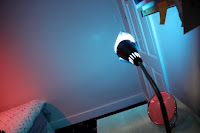
  To prepare for my shoot, I wanted to test out how the bedroom and it's lights worked with the blue and pink lighting gels I wanted to use on my shoot. I originally tried mixing red and pink gels - thinking that the red would provide a warmth, however I found that the colour wasn't strong enough and that completely pink worked a lot better. 


half Pink (002) gels and half Red (111) gels


completely Pink (002) gels


completely blue (141) gels


half pink and half blue gels


 I have decided to begin by lighting with three blue gels and one pink gel to brighten the room. I am using the lights in the room as they give an extreme, naturalistic light.


 In order to create a half and half look with the pink and blue lights, I needed to include a blue gel on a lamp pointed at the subject in order to get the colour necessary and have the effect in the shadows that worked so well.

To acquire the extreme pink used in the latter half of my film, I used all four of the pink gels. 

Saturday, 24 November 2018

Initial Ideas, Proposal and Development

 After researching Maya Angelou's life I knew I wanted to make my film about a social issue, inspired by her time as a civil rights activist. When reading the poem I reflected its ideas through my struggles to feel comfortable as a genderfluid person and wanted to reflect this is in my film by showing somebody battling with gender dysphoria in a way that was very up-close and personal.

My initial proposal: (dated 15/11/18)
"Proposal
Based on: ‘Life Doesn’t Frighten Me’ by Maya Angelou
A gender-fluid student prepares for their prom, searching for the bravery and confidence to wear what they want.


 A group of students walk down the street, chatting excitedly about a party. The girls are deciding what time they’re meeting and who’s helping who with make-up whilst the boys talk about ‘pulling techniques’ – they’re all arguing over who’s going to get more drunk. Having remained silent and not a part of either conversation, one of the group breaks off and walks into their home.
 We see them getting ready for the party through slow, drawn out close-ups. Shaving a leg, painting their nails etc. As the scene unfolds, we realise the student is gender-fluid and preparing to wear what they want publicly for the first time.
 They leave the house and we follow, people stare and a few stop walking to look. They pass beautifully made up women and a group of ‘lads’ on a night out.  As they arrive at the party, the stares and confusion have become confidence and bravery."

I decided to remove the narrative of the idea in order to really focus on the core idea of the film within 5 minutes.

 The lighting workshop was very important to how I want the film to look. We found very interesting effects when mixing colours and how this affected shadows and I will light my film with very strong blue and pink lights to reflect the idea of binary gender and mix them as it breaks down throughout the film.
 I have decided to use naturalist lighting, using the lights in the room, covered with gels for a strong, harsh look that I hope - in a way - reflects Jean-Michel Basquiat's bold illustrations from the original book.

storyboard
shot list