Tuesday, 27 November 2018

Gel Test

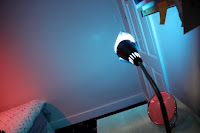
  To prepare for my shoot, I wanted to test out how the bedroom and it's lights worked with the blue and pink lighting gels I wanted to use on my shoot. I originally tried mixing red and pink gels - thinking that the red would provide a warmth, however I found that the colour wasn't strong enough and that completely pink worked a lot better. 


half Pink (002) gels and half Red (111) gels


completely Pink (002) gels


completely blue (141) gels


half pink and half blue gels


 I have decided to begin by lighting with three blue gels and one pink gel to brighten the room. I am using the lights in the room as they give an extreme, naturalistic light.


 In order to create a half and half look with the pink and blue lights, I needed to include a blue gel on a lamp pointed at the subject in order to get the colour necessary and have the effect in the shadows that worked so well.

To acquire the extreme pink used in the latter half of my film, I used all four of the pink gels. 

Saturday, 24 November 2018

Initial Ideas, Proposal and Development

 After researching Maya Angelou's life I knew I wanted to make my film about a social issue, inspired by her time as a civil rights activist. When reading the poem I reflected its ideas through my struggles to feel comfortable as a genderfluid person and wanted to reflect this is in my film by showing somebody battling with gender dysphoria in a way that was very up-close and personal.

My initial proposal: (dated 15/11/18)
"Proposal
Based on: ‘Life Doesn’t Frighten Me’ by Maya Angelou
A gender-fluid student prepares for their prom, searching for the bravery and confidence to wear what they want.


 A group of students walk down the street, chatting excitedly about a party. The girls are deciding what time they’re meeting and who’s helping who with make-up whilst the boys talk about ‘pulling techniques’ – they’re all arguing over who’s going to get more drunk. Having remained silent and not a part of either conversation, one of the group breaks off and walks into their home.
 We see them getting ready for the party through slow, drawn out close-ups. Shaving a leg, painting their nails etc. As the scene unfolds, we realise the student is gender-fluid and preparing to wear what they want publicly for the first time.
 They leave the house and we follow, people stare and a few stop walking to look. They pass beautifully made up women and a group of ‘lads’ on a night out.  As they arrive at the party, the stares and confusion have become confidence and bravery."

I decided to remove the narrative of the idea in order to really focus on the core idea of the film within 5 minutes.

 The lighting workshop was very important to how I want the film to look. We found very interesting effects when mixing colours and how this affected shadows and I will light my film with very strong blue and pink lights to reflect the idea of binary gender and mix them as it breaks down throughout the film.
 I have decided to use naturalist lighting, using the lights in the room, covered with gels for a strong, harsh look that I hope - in a way - reflects Jean-Michel Basquiat's bold illustrations from the original book.

storyboard
shot list

Thursday, 22 November 2018

Break Free - Ruby Rose notes

Break Free (2014) [x]
A short film about gender roles, Trans, and what it is like to have an identity that deviates from the status quo.
Written/Produced/Strarring: Ruby Rose Music: Butterfly Boucher "It pulls me under" https://www.youtube.com/user/thebutte... Directed/Edited: Phillip Lopez Styled: Phoebe Dahl

multiple angles
begins by completing 'feminine' look - shoes, lips and hair
begins with feminine look for enigma, so scissors immediately draws you in
then completely flips by chopping hair
slower fps
lots of close ups
handheld and almost shaky
'washes' self to reveal tattoos
has 'macho' moment  to camera - feels like mirror moment psyching self up - reminiscent of Taxi Driver
Can be watched forwards or backwards, reflecting binary sides of dysphoria

 I love the way that this film can mostly be watched backwards to present the same story but reflecting the transformation from male to female. This is an idea I want to try and repeat in my own production, I will try to plan the actions of my piece to achieve this and mirror my first and final shot to bookend the film.

Casting & Location Recce

Jack's screen test / lighting test

Casting: I have decided to use my part-time actor-friend, Jack for a variety of reasons: we have a very strong working relationship and have worked on many projects before and his appearance lended itself to the project.  Ideally I would have opted for a queer actor but because of the films personal themes I decided that mine and jack's past experience on-set was more beneficial for making the shoot comfortable for everybody.


Shots of room taken during recce/lighting test


 Location I decided to use a student house with white walls as they worked best with the bold lighting design I required for my film. I decided on prominently bare walls with no set dressing as I felt that anything else could have been distracting for the eye.


Wednesday, 21 November 2018

Lighting Workshop - 20/11

Creates dimension and depth to shots - flat lighting is unattractive and unprofessional

Two main philosophies towards lighting
Naturalism: Intended to replicate realistic lighting, placing lights at points where actual light sources are. EG Windows, Room lights. Naturalist lighting can also be used by low-budget filmmakers to save money and give their movies a more realistic look.
Pictorialism: Placing lights in order to get the most desirable look from the shot, regardless of continuity etc.

image two

Two main types of lighting:

image one
High-Key: Everything is lit, giving full vision to the scene. Typical for lighter movies EG comedies and romance


image three
image four
Lo-Key: Lighting is used sparingly, focusing on highlights and a dramatic, impactful look. Shadows are more defined Used for modern dramas or films with a 'gritty' look. 

The two shots from Harry Potter (image one: Harry Potter and the Deathly Hallows Part Two [2011, David Yates] & image four: Harry Potter and the Prisoner of Azkaban [2004, Alfonso Cuaron]) show how different types of lighting can be used within one continued series. One image representing hope and the other showing fear.

Properties of light:
Brightness - How intense is the light?
Colour - Is it natural day light or artificial lights such as LED or tungsten?? Are you using gels to create an emotional impact?
Quality - Is the lighting hard to create strong, deep shadows or soft to show minimise shadows?
Angle - Where are they placed in relation to the subject? Are the lights direct or being bounced off of a surface to soften them?
Shape

Three Point Lighting -
We experimented with three-point lighting and what happens when combining different colours. We found that by bouncing the backlight off of the wall, we could also influence the colour of the shadows for a very interesting effect.


I want my film to have a naturalist look with low-key lighting to represent the fear and anxiety the protagonist is feeling and to use shadow to show the duality of their personality and the 'two-sides' of their gender. Towards the end of the film, once they're fully dressed and able to show themselves as they feel they are - they will step out into full light, hopefully connoting that they now feel more complete. I want to combine blue and pink gels - opposing the stereotypical gender of the item on screen at the time to reflect the dissonance of their 'self'. 

Friday, 16 November 2018

Life Doesn't Frighten Me

Life Doesn't Frighten Me
Published in '93 and became the title of collaborative book with Jean-Michel Basquiat.
Basquiat's pictures are dark and powerful but considered by some 'too strong' for Angelou's words. His purposely childlike style reflects the simplicity of Angelou's words and reveals the emotions and powerful imagination of a child. 

Angelou said she wrote the poem for all children who whistle in the dark and refuse to admit they're frightened out of their wits. 


The poem is simplistic and repetitive as if from a child perspective
Short, lyrical stanzas that lend themselves to performance 
Jean Michel Basquiat's illustrations 
Angelou: I've learned that people will forget what you said, people will forget what you did, but people will never forget how you made them feel.'

The poem is about overcoming fear - moving past bravado and having a reason for bravery. 


Thursday, 15 November 2018

Maya Angelou

https://www.poetryfoundation.org/poets/maya-angelouhttps://www.poetryfoundation.org/articles/70265/maya-angelou-101https://www.mayaangelou.com/biography/https://en.wikipedia.org/wiki/Maya_Angelou#Life_and_career

Maya Angelou


born Marguerite Johnson in St. Louis, Missouri

Varied career including: nightclub performer, composer, and Hollywood’s first female black director. Not to mention seven autobiographies, three books of essays and various poetry books and being Hollywood's first black, female director. 

Also an avid civil rights activist, Angelou worked with Dr. King jr and Malcolm X. She served on two presidential commitees, with Ford in 75 and Carter in 77.

Before her death in 2014, she was awarded over 50 honorary awards, including National Medal of Arts by Clinton in 2000 and the Presidential Medal of Freedom (the highest US civilian honour) by Obama in 2010. 


Angelou became a member of the Harlem Writer's Guild in last 1950's where she met James Baldwin, a black writer "whose eloquence and passion on the subject of race in America made him an important voice." (https://www.britannica.com/biography/James-Baldwin)

It was during this time she became inspired by Dr. Martin Luther King's message and became a part of civil rights movement and became northern co-ordinator for Dr King's Southern Christian Leadership Conference (SCLC)


Following this, she moved to Ghana in West Africa in 1962 and upon er return to the states became work on 'I know why the Caged Bird Sings', her first book that told her story from childhood to the birth of her first son. The book was an immediate success and is taught in schools to this day despite controversy over her honest portrayal of race, sexual abuse and violence. 

"Angelou’s use of fiction-writing techniques like dialogue and plot in her autobiographies was innovative for its time and helped, in part, to complicate the genre’s relationship with truth and memory. Though her books are episodic and tightly-crafted, the events seldom follow a strict chronology and are arranged to emphasise themes."


A widely-read and highly revered poet, her 1971 Just Give Me A Cool Drink of Water 'fore I Diiie was nominated for a Pulitzer prize the following year. 

Carol Neubauer wrote in Southern Women Writers, “the first twenty poems describe the whole gamut of love, from the first moment of passionate discovery to the first suspicion of painful loss.” In other poems, “Angelou turns her attention to the lives of black people in America from the time of slavery to the rebellious 1960s. Her themes deal broadly with the painful anguish suffered by blacks forced into submission, with guilt over accepting too much, and with protest and basic survival.”

As well as autobiographies and poems, Angelous had a successful career in film and TV too. In 1972 she became the first black woman to have a screenplay produced with Georgia, Georgia and was nominated for an Emmy for her time in Roots in 1977. In 79 she helped adapt her first book into a television movie of the same name. 

Asked by Bill Clinton to read and write an inaugural poem, in the early 1990s Americans across the country heard Angelou read On the Pulse, a call for peace between races and cultures and humankind.

Angelou also wrote several books for children in the early 90s. Life Doesn’t Frighten Me (1993), which also featured the work of Jean-Michel Basquiat; My Painted House, My Friendly Chicken, and Me (1994), and Kofi and His Magic (1996), both collaborations with the photographer Margaret Courtney-Clark.

Her poetry was at it's best when performed and she performed to countless spellbound audiences, astounded as she bore her soul and commented on topics like race and sex on a social and psychological scale. She once said “Once I got into it [poetry] I realized I was following a tradition established by Frederick Douglass—the slave narrative—speaking in the first-person singular talking about the first-person plural, always saying I meaning ‘we.’ And what a responsibility. Trying to work with that form, the autobiographical mode, to change it, to make it bigger, richer, finer, and more inclusive in the twentieth century has been a great challenge for me.”